
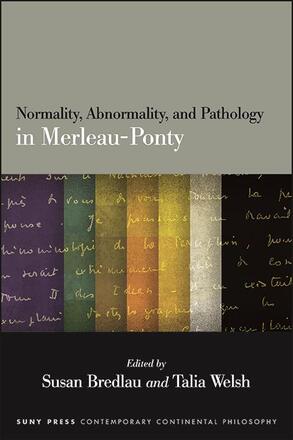
New Chapter Published: The Need for Merleau-Ponty in Foucault’s Account of the Abnormal

My chapter has been published in an edited collection on Merleau-Ponty. The title of the chapter is “The Need for Merleau-Ponty in Foucault’s Account of the Abnormal” and is in the book, Normality, Abnormality, and Pathology in Merleau-Ponty, edited by Talia Welsh and Susan Bredlau. You can purchase the hardcover on Amazon or at SUNY press. The paperback should come out in late summer 2022.

Here is a pdf of my chapter.


Here is the abstract:

Due to both his historical contributions as well as the simple persuasive power of his writing, many of us are drawn to the work of Michel Foucault on the history of the abnormal. And yet, while we acknowledge the insights offered by his account of the abnormal, we may feel that something is missing from his historical narrative and wonder if it can be fully trusted. In this chapter, I will argue that we can only successfully draw on Foucault’s work on the abnormal once we recognize that it is Merleau-Ponty’s work in psychology that serves as its hidden foundation.

To do so, I begin by giving a brief summary of Foucault’s account of the abnormal according to his 1961 History of Madness and his 1974-1975 lectures entitled Abnormal. Foucault describes how the abnormal of the modern age comes out of an understanding of madness that can be traced in the previous ages. He then reveals some common historical structures present in each age; in particular, how the notion of madness is dependent on the societal constructions of the rational and the nonrational. But we are left asking: Where are these constructions coming from? And why is madness inextricably linked to our understanding of the rational and nonrational in every age? Foucault’s account of the abnormal seems to tell us how the notions of madness play out in society, but offers no explanation for why the historical structures are shaped in this way. 

I turn to Merleau-Ponty for aid and find that the very historical structures recounted by Foucault are actually rooted in Merleau-Ponty’s phenomenological patterns of the abnormal. Drawing on the Phenomenology of Perception, I describe the phenomenological foundation of the abnormal as a way to make madness both accessible and meaningful. We find that this foundation is precisely what is needed for the arbitrary historical constructions of Foucault. To close, I look at the presence of these patterns in the disorder of schizophrenia, demonstrating how the unity of a historical-phenomenological account of the abnormal can provide deeper insights into the experience of a mental disorder.

My book, Madness in Experience and History, is published!

My book has been published! You can order it now through Routledge and Amazon.

Title: Madness in Experience and History: Merleau-Ponty’s Phenomenology and Foucault’s Archaeology

Back of the Book Blurb:

Madness in Experience and History brings together experience and history to show their impact on madness or mental illness. 

Drawing on the writings of two 20th century French philosophers, Maurice Merleau-Ponty and Michel Foucault, the author pairs a phenomenological approach with an archaeological approach to present a new perspective on mental illness as an experience that arises out of common behavioral patterns and shared historical structures. Many today feel frustrated with the medical model because of its deficiencies in explaining mental illness. In response, the author argues that we must integrate human experiences of mental disorders with the history of mental disorders to have a full account of mental health and to make possible a more holistic care.

Scholars in the humanities and mental health practitioners will appreciate how such an analysis not only offers a greater understanding of mental health, but also a fresh take on discovering value in diverse human experiences.

Conference Presentation: Virtual Symphony and Virtual Church: Considering the Importance of Bodily Presence

I had the opportunity to present a presentation titled, “Virtual Symphony and Virtual Church: Considering the Importance of Bodily Presence” at the virtual 2021 Psychology and the Other Conference on September 19, 2021.

Here is my short summary and longer abstract:

Short Summary

This paper weighs in on the question of virtual church, particularly on whether or not liturgy can be done virtually. We will approach our subject from an unusual perspective by looking first to aesthetic experiences, such as watching a virtual symphony, and then relate them to liturgical experiences, such as attending virtual church. Art and liturgy are linked in that they both have the unique ability to facilitate presence, to make something known to us in a new way so that we walk away changed. I argue that what art teaches us about the importance of the body applies to the practice of liturgy and that, while unexpected benefits will surface in virtual settings, nothing replaces the powerful experiences that arise when the body is physically present.

Longer Abstract

No one will deny that there is a substantial difference between meeting in person and meeting virtually. Now, more than ever due to the covid crisis, we have experienced virtual gatherings in almost every sphere of our lives. For religious gatherings, these types of discussions have been of critical importance, sometimes causing great tension and conflict between members of the same communities. This paper weighs in on the question of virtual church, particularly on whether or not liturgy can be done virtually. We will approach our subject from a somewhat unusual perspective by looking first to aesthetic experiences, such as watching a virtual symphony, and then relate them to liturgical experiences, such as attending virtual church. Art and liturgy are linked in that they both have the unique ability to facilitate presence, to make something known to us in a new way so that we walk away changed. I argue that what art teaches us about the significance of the physical closeness of the human applies to the practice of liturgy and that, while unexpected benefits will surface in virtual settings, nothing replaces the powerful experiences that arise when the body is physically present.

Beginning with art, we consider aesthetic experiences such as viewing a photo of a painting or listening to a music recording or attending a virtual symphony. Drawing on Mikel Dufrenne, Maurice Merleau-Ponty and Gabriel Marcel, we explore how art has a way of pulling us beyond the constraints of space and time in order to experience presence. And yet, the most powerful moments of presence are when the body is at the same place and in the same time as the work of art, such as discovering the original painting at a museum or attending an in person symphony. 

Next, I consider the weight of the body in experiences of presence in liturgical practices, both in person and virtual, guided again by Gabriel Marcel as well as Bruce Ellis Benson, Emmanuel Falque, Christina Gschwandtner and Éric Palazzo. Considering liturgy as both what happens in worship gatherings and in daily life, we will discuss three aspects of liturgy to understand the role of presence in its practices: liturgy as art, liturgy as bodily, and liturgy as communal. We find that liturgy as art draws us into worshipping and into shaping our souls, liturgy engages all five senses of the body and liturgy lives only in communal settings. I will relate this three-part understanding of liturgy to virtual and non-virtual experiences and argue that a full experience of liturgy must include the bodily presence of the self and others.

Applying the insights from aesthetic experiences to liturgical experiences, we discover the importance of bodily presence in all areas of life. This discovery, ultimately, provides further validation to treating humans as undivided wholes, with full integration of mental and physical capacities, and awakens us to the deep experiences of presence that we have available when we are fully engaged.

Summer Update 2021

I made a summer research update last year (see here) and thought I would continue the tradition this year. It helps me see what I have accomplished this past year and what things I have in progress.

Recently Published

Article: “The Carnival of the Mad: Foucault’s Window into the Origin of Psychology,” Foucault Studies 30 (June 2021).

Article: “The Weight of Bodily Presence in Art and Liturgy.” Religions 12, no. 3: 164 (2021): 1-14. Invited article for special issue entitled “Phenomenology and Liturgical Practice.”

Upcoming Publications

Chapter in Edited Book: “The Need for Merleau-Ponty in Foucault’s Account of the Abnormal.” In Normality, Abnormality, and Pathology in Merleau-Ponty, edited by Talia Welsh and Susan Bredlau, SUNY Press. Abstract. All revisions have been finalized and it should be published very soon.

My Book! Madness in Experience and History: Merleau-Ponty’s Phenomenology and Foucault’s Archaeology. Forthcoming December 2021 with Routledge. Part of the Psychology and the Other Book Series. The full manuscript has been submitted and it is currently in the production phase. This summer, I will be doing the final edits and compiling the index.

Currently Working On

Article: No title yet. Something on Foucault’s unreason (déraison) and Victor Hugo’s display of madness in Les Miserables.

Joint Book Project with Dr. Mark Allen. Tentative title: Art and the Flourishing of the Ordinary. Our goals for the summer are to write a joint abstract and start contacting some publishers. Related to Mark’s dissertation on art and philosophy and my master’s thesis on existential aesthetics.

Joint Article with Dr. Mary Schwarz. Tentative title: “Reclaiming our Lost Identity with Marcel: A Response to Suicide and Other Acts of Self-Harm.” Planning on submitting this to the journal Marcel Studies.

Future Work

Article. No title yet. Something on disability as a way of accessing the world but also a mode of suffering in the world.

Future Big Project. Something on the phenomenology of suffering and pain.

Faculty Position!

I am happy to announce that I have accepted a position as assistant professor of philosophy at the University of Mary. We will be moving to North Dakota later this summer and I will start the position this Fall 2021.

The University of Mary is a well-rounded Catholic school with a hospitable and welcoming community. I am so looking forward to joining them this fall!

Watch this short video to learn more about the University of Mary.