My chapter on art and suffering is now published in the Routledge anthology, Aesthetic Ethics.
It is so great to see this in print! This is the fruit of my research that I did in France during the summer of 2024! Here is my previous post on my work during that summer. What a great summer!
When faced with tragedy, human language often fails, forcing us to admit that there are some experiences that words cannot explain. In this silent space of deep suffering, art has a sole voice as it is able to speak to us in a language all its own. Because of this ability, I will argue that art has an ethical obligation to speak into our sufferings. Drawing on Maurice Merleau-Ponty’s idea that art arises out of silence and Friedrich Nietzsche’s famous claim that art justifies existence, I will first offer further proof for why it is that art must speak of suffering. Next, I will describe how art fulfills this obligation due to its natural use of the vocabulary surrounding suffering including death, brokenness, despair and absurdity as seen in illustrations from the art of the French existentialists, Simone de Beauvoir, Gabriel Marcel, Jean-Paul Sartre and Albert Camus. Lastly, I will reveal what art says to us in the midst of suffering to demonstrate its indispensability; for it is the uncompromising message of art which refuses to soften reality while also calling us to action that makes it possible for us to bear the suffering.
I had the opportunity to present a portion of my work on art and suffering, specifically in relation to death, at the American Catholic Philosophical Association hosted at the University of Notre Dame in October 2025
Here is an abstract of the paper:
There is a kind of silence opened up by experiences of death that enters into both personal and political contexts. Because death serves as a crude reminder that there is something not quite right in this world, any effort to explain death will always fall short. We can never provide a satisfying justification for it. This inability of language to respond to death represents a silent gap uncovered in diverse encounters with death. When we lose a loved one early and unexpectedly, the loss pierces us in such a way that our first articulations are to deny that it actually happened. And, even when the death of loved ones comes after a long life, the idea that at least they lived a good, long life does not eradicate our sorrow at their absence. The injustice of death makes us struggle to come up with words to say to someone in a sympathy card or at a funeral. “I’m sorry for your loss” feels empty and cliché and yet better than not saying anything at all. On a political level, the shocking death tolls from the conflicts around us overwhelm us making us speechless. And, despite its inevitability, we avoid the topic of our own death in everyday conversation. The silence evoked by death in all its forms is thus found not only in the way we might abstain from the subject, but also in the fact that the words that are spoken feel bereft of meaning, as if they were nothing.
In this paper, I will argue that art fills in the space left empty by normal language by speaking its own language about death. And while it is no surprise philosophically or experientially that art helps us bear death, I will offer an additional perspective on this by linking the way art speaks out of a general silence to the way it speaks out of the particular silence felt in experiences of personal and political death. To do so, I will first present how art arises out of silence, according to Maurice Merleau-Ponty, and relate this to the silence of death. Next, I will describe the powerful vocabulary that art uses to speak to death drawing on illustrations found in the art of the French existentialists. Lastly, I will conclude that it is the uncompromising message of art which refuses to soften reality while also calling us to action that makes it possible for us to bear the reality of death. As a note, when I say that art has the ability to do something, I do not mean that every single piece of art does this, but rather that art, as a practice, has this capacity. The characteristics discussed in this paper are not necessarily found (nor should they be found) in each individual work of art.
I presented at the International Network of Philosophy of Religion conference which took place in Perugia, Italy on June 11, 2024. It was a wonderful conference connecting with old friends and meeting new ones. The location was beautiful overlooking several small cities including Assisi (where St. Francis was from).
Here is a picture from the back of the hotel.
The conference is both in French and English so I wrote my abstract in both. And like last time, I read my paper in English but read the longer quotations in the original French.
Title: Art Speaks the Unspeakable: Suffering of the World in Aesthetic Expression
Abstract. Responding to the discussion on solitude and tragedy (the “extra-phenomenal”), at our last conference, and reflecting on the crisis of our created world, for this conference, this paper looks to the power of art to speak into the silent spaces of deep suffering. Because there are events where no human language — not even the language of phenomenology — can offer us a satisfying response, art has an ethical obligation to speak to us in the midst of personal and global suffering. Drawing on Maurice Merleau-Ponty’s idea that art emerges out of silence, I will first offer further proof for why it is that art must speak of suffering. Next, I will describe how art fulfills this obligation due to its facility with the vocabulary surrounding suffering, for example, death and brokenness, as seen in illustrations from the art of the French existentialists, Simone de Beauvoir, Gabriel Marcel, Jean-Paul Sartre and Albert Camus. Lastly, I will present what art says to us in suffering to demonstrate its indispensability; for the uncompromising message of aesthetic expression reveals to us the fullness of reality, the hard and the good, unlike anything else.
L’art dit l’indicible: souffrance du monde dans l’expression esthétique
Le résumé. Répondant à l’échange sur la solitude et la tragédie (le “Hors-phénomène”), lors de notre dernière conférence, et réfléchissant sur la crise de notre monde créé, pour cette conférence, cet article se penche sur le pouvoir de l’art de parler dans les espaces silencieux de la souffrance profonde. Parce qu’il y a des événements où le langage humaine — même le langage de la phénoménologie — ne peut pas nous offrir une réponse satisfaisante, l’art a une obligation éthique de nous dire quelque chose au milieu de la souffrance personnelle et globale. Faisant appel à l’idée de Maurice Merleau-Ponty selon laquelle l’art émerge du silence, j’offrirai tout d’abord une preuve en plus du fait que l’art doit parler de la souffrance. Ensuite, je décrirai comment l’art remplit cette obligation par sa richesse de vocabulaire du domaine de souffrance, par exemple, la mort et le monde cassé, comme le montrent les illustrations des arts des existentialistes français, Simone de Beauvoir, Gabriel Marcel, Jean-Paul Sartre et Albert Camus. Et enfin, je présenterai ce que l’art nous dit dans la souffrance pour démonter sa nécessité ; car le message intransigeant de l’expression esthétique nous révèle la plénitude de la réalité, du dur et du bien, contrairement à toute autre chose.
I was accepted to participate in a Seminar and Conference this summer on Phenomenology and Revelation. It was an amazing 10 days at a retreat center in Long Island, New York with excellent presentations and deep conversations.
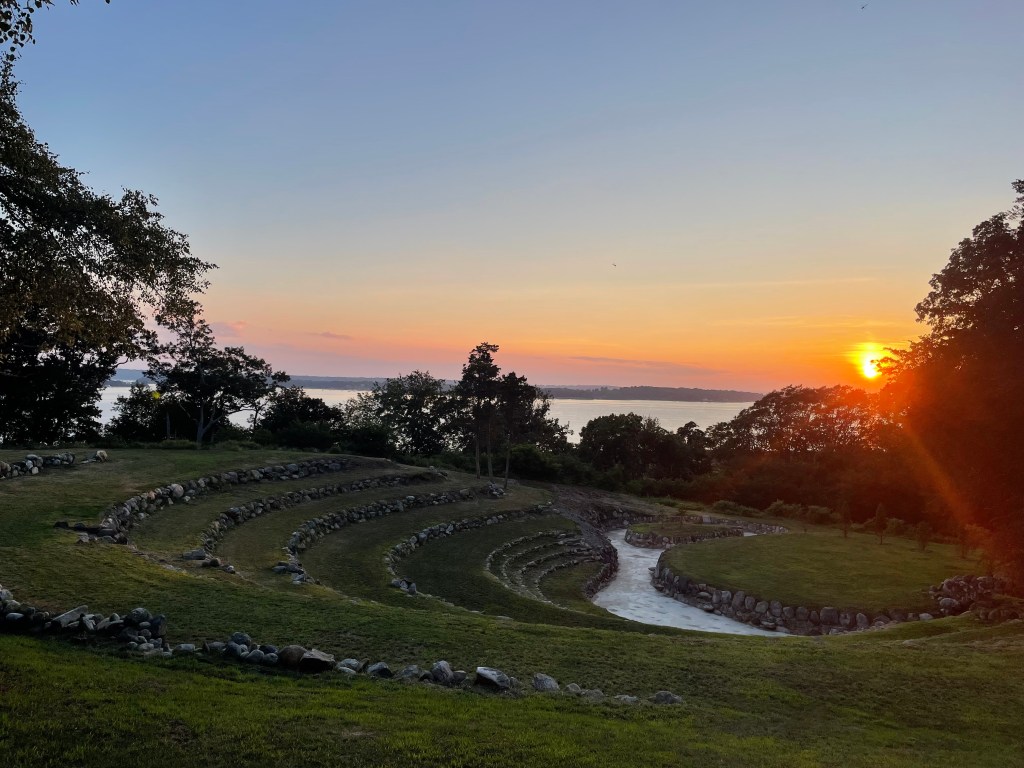
Here is a picture of the sunset at the retreat center overlooking the bay.
Abstract: No matter what angle we try, whether it is philosophical, theological or even practical, it is very difficult to make sense of suffering. Easy answers may suffice at first, but once we walk through a tragedy of our own or are exposed to some real suffering in the wider world, we are no longer satisfied and are compelled to search for something better. Although many perspectives can aid us in this, phenomenology offers a response to suffering that actually takes into account the magnitude and depth of the experience. This is because a phenomenological approach demonstrates concretely — not abstractly — how revelation is experienced in the midst of suffering in ways other approaches cannot do. More often, we focus on how revelation is something given prior to suffering in order to aid us in enduring it such as the promise of the land that the Israelites were given before they had to wander in the desert for forty years. Or we may think of revelation as a reward given after suffering such as the blessings that Odysseus receives after his long faithful journey through many hardships to return to his family. While these are important contributions to understanding revelation and suffering, phenomenology takes a radical stance by designating suffering as a mode of revelation itself. To illustrate this, I will first offer a phenomenological sketch of suffering, next describe what kind of revelation is available in suffering and conclude by arguing for the merits of drawing on phenomenology to establish the unique role that revelation plays in suffering.
I had the opportunity to present at the International Merleau-Ponty Circle in Washington D.C. on November 11, 2022. I was so excited that the theme of the conference was disability. The conference was titled: FITS AND MISFITS: RETHINKING DISABILITY, DEBILITY, AND THE WORLD WITH MERLEAU-PONTY.
Here is an abstract of my paper:
Equating the experience of suffering with the experience of disability runs contrary not only to a general understanding of human life, but also to a thoughtful approach to disability. To assume that disability is the same as suffering is certainly to misunderstand disability, as many others have shown. But, as I will argue, to assume that disability is the same as suffering is also to misunderstand suffering. Could it be that our incorrect view of suffering impacts the way that we see disability? I propose that, in order to understand the role that suffering may play in disability, we need to rethink what we mean by suffering and what kind of suffering could be present in disability.
To do so, I will briefly present some of the difficulties — philosophical, social, and practical — that are found in even discussing a relationship between suffering and disability. Second, drawing on Merleau-Ponty and Kierkegaard, I will argue for an expanded view of suffering where the good of suffering is not found in a future result, but in its placement in the present world and in its manifestation of joy in the present moment. Third, I will apply this expanded notion of suffering to disability in order to suggest what a reimagined relationship might look like between disability and suffering. While this new relationship is not meant to be universal nor comprehensive for all areas of disability, it does provide a helpful vocabulary that adds to a rich phenomenological account of disability.


 Through Wonder