
Summer 2024: Research in France

I have had the opportunity to live in Nîmes, France this summer to do further research, improve my French and participate in a couple of European conferences. It has been a wonderful summer with easy access to philosophy books at the local bookstores and at the library. I’ve also taken some French classes at a nearby language school.

In May, I participated as a respondent at one of the philosophy doctoral seminars at the Institut Catholique in Paris. I gave a “Response to Karl Hefty’s ‘Toward a Phenomenology of Mercy.'”

Here is a picture of the Institut Catholique de Paris.

Here is my abstract of my short response to Hefty’s paper:

Karl Hefty offers us rich and deep reflections on the beginnings to a phenomenology of mercy. In my response, I will first give a brief summary of the six parts of Hefty’s paper. Next, I would like to add one more Biblical reference to mercy that signifies the connection between mercy and life. This reference is to the “mercy seat” that serves as the lid to the ark of the convenant in Exodus and is discussed again in the book of Hebrews. To spur discussion, I will then challenge Hefty’s understanding of suffering and suggest that an expanded notion of suffering would reflect human life more authentically and give us an even fuller account of mercy. Specifically, I will argue that mercy does not always have the goal of “taking away suffering” because suffering lays out goods for us in and of itself and because suffering can be a gift that is given to us out of mercy.

While I’ve been in here in France, my research has been primarily on the relation between art and suffering. I will present a version of this paper at a conference in Italy (which I will post separately about). But I plan on publishing a completed version in an edited collection, Aesthetics Ethics, which should be available next year. It is also hopefully part of a future book on art and ordinary living that I am writing with my friend, Mark Allen.

For my research, I have focused on tracking down the French sources for many of the books that I use in my chapter. Many of these books are easily found at the local bookstores. Here are some that I’ve purchased.

The ones that I can’t find at the bookstores have been at the local library here in Nîmes (Bibliothèque Carré d’Art). Here is a picture of the library.

Here are some of the books that I’ve checked out.

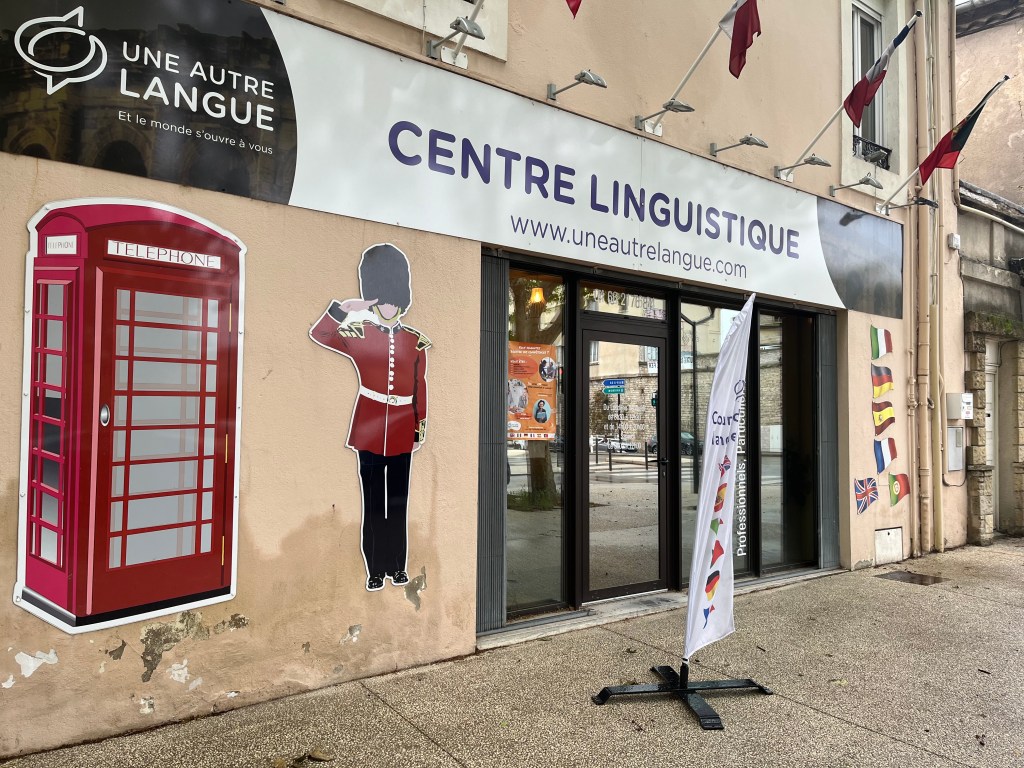
I have also had the opportunity to improve my French by everyday dialogue on the streets and by taking some classes at a local language school called Une Autre Langue.

Here is a picture of the language school.
University of Mary Convocation on My Book!

I received a Faculty Excellence Award and had the opportunity to present a convocation at the University of Mary on November 4, 2022 on my book.

University of Mary did an excellent recording of this convocation which you can view here.

Convocation on Madness in Experience and History

To purchase a book, you can go to Amazon and Routledge. Discount code for Routledge: AEVV22.

Here is the flyer that went up around campus.

Summer Update 2022

I am continuing my tradition of giving a summer update. It helps to see what I have accomplished this past year and what plans I have for the future.

Recently Published

My Book! Madness in Experience and History: Merleau-Ponty’s Phenomenology and Foucault’s Archaeology. This was published in November 2021!  You can order it now through Routledge and Amazon.

Chapter in Edited Book: “The Need for Merleau-Ponty in Foucault’s Account of the Abnormal.” In Normality, Abnormality, and Pathology in Merleau-Ponty, edited by Talia Welsh and Susan Bredlau, 97-115. New York: SUNY Press, 2022. You can purchase the hardcover on Amazon or at SUNY press. The paperback should come out in late summer 2022.

Upcoming Publications

Chapter in Edited Book: “Foucault’s Care of Self: A Response to Modern Technology.” In Routledge International Handbook for Psychoanalysis, Subjectivity and Technology, edited by David Goodman and Matthew Clemente. Forthcoming with Routledge.

Book Review: “Centrality of Touch: A Review of Richard Kearney’s Touch.” The review will be published along with one or two other reviews and Kearney’s response to them in the journal: Crossing: The International Network of Philosophy and Religion. The book, Touch, is an excellent introduction to approaching the world in a phenomenological way. I recommend it!

Currently Working On

Conference Presentation: “The Secret of Madness: Foucault’s Overarching Nonrational” for the International Network of Philosophy and Religion being held this June 2022 in Paris, France.

Conference Presentation for the International Merleau-Ponty Circle (and hopefully later an article for the new Journal of Philosophy of Disability). No title yet. Something on disability as a way of accessing the world but also a mode of suffering in the world.

Convocation Presentation: “Madness in Experience and History.” I’ve won a Faculty Excellence Award and will be presenting on my book on November 4, 2022 at the University of Mary.

Future Work

Joint Book Project with Dr. Mark Allen. Tentative title: Art and the Flourishing of the Ordinary. Related to Mark’s dissertation on art and philosophy and my master’s thesis on existential aesthetics.

Article: No title yet. Something on Foucault’s unreason (déraison) and Victor Hugo’s display of madness in Les Miserables

Joint Article with Dr. Mary Schwarz. Tentative title: “Reclaiming our Lost Identity with Marcel: A Response to Suicide and Other Acts of Self-Harm.” Planning on submitting this to the journal Marcel Studies.

New Class This Fall: Aesthetics/Philosophy of Art and Beauty

I will be teaching a new class this fall (Fall 2022)! The title is Aesthetics/Philosophy of Art and Beauty.

What is art? What is beauty? Is art just a side hobby? Is it something only for the elite? Are there any limits for what can be considered art? Or is art just anything we want it to be? What does art tell us about beauty? Does art have to be beautiful?

Come study the importance of art and beauty through a philosophical and artistic perspective!  In this class, we will cover the essential writings on aesthetics in philosophy while also taking time to actually experience different art forms together, such music, painting, nature art, poetry and more. Throughout it all, we will reflect on how art plays an essential role in our human experience and has a unique way of revealing the good, true and beautiful to us.

Conference Panel Presentation: The Roots of Technological Prosthesis and Hope in Foucault’s Care of Self

I had the opportunity to be part of a panel presentation for the Society for Pscyhoanalysis and Psychoanalytic Psychology, Division 39. The title for our panel was “Technological Prosthesis: Transcending Finitude and the Trauma of Death” and Matthew Clemente, David Goodman, Eric Severson along with myself were the panelists. We presented virtually on April 10, 2022.

Here were my four main points:

First, as we have seen, cultural and philosophical phenomena loudly proclaim technology as a way of transcending the human experience. Do we hear any murmurs of discomfort about this idea in other films? Examples: Gravity, Ad Astra

Second, this turn to technology as a savior arises out of a reduced understanding of human subjectivity. A fuller understanding of subjectivity can be seen through a Foucault’s historical tracing of the idea of “care of self.”

Third, the roots of the technological prosthesis comes out of a reduction of “care of self” to “knowledge of self” which takes place in modernity. This is what gives rise to a consideration of humans as disembodied acquirers of knowledge, who can be enhanced by technological means.

Fourth, let’s consider now (1) examples of everyday technologies that are mistakenly used in an attempt to transcend human experience and (2) examples of everyday technologies which allow for the possibility of proper self-care.