Article Published: Miracle in Myth: Nietzsche on Wunder

I am happy to announce that my article on Nietzsche and miracle has been published! It was published in the journal Religions and is part of a special issue on “The Intersection of Phenomenology and Religion.” You can see it online here and download a pdf.

I am also putting a pdf of it here.


Here is the abstract:

This paper considers the experience of miracle through the writings of Friedrich Nietzsche. Although he is often considered an anti-religious thinker, I argue that Nietzsche actually puts forth a positive conception of miracle because of its indispensable role in the creation of myth. I walk through Nietzsche’s texts to describe his account of miracle (Wunder) and to demonstrate how it reveals a phenomenological perspective on miracle by placing it and rooting it in human life. Despite his rejection of traditional religion, Nietzsche reminds us that miracles are not an anomaly to human experience, but rather they are the way in which humans are able to embrace and affirm life through participation in myth.

Conference Presentation: Reimagining the Relationship between Suffering and Disability with Merleau-Ponty and Kierkegaard

I had the opportunity to present at the International Merleau-Ponty Circle in Washington D.C. on November 11, 2022. I was so excited that the theme of the conference was disability. The conference was titled: FITS AND MISFITS: RETHINKING DISABILITY, DEBILITY, AND THE WORLD WITH MERLEAU-PONTY.

Here is an abstract of my paper:

Equating the experience of suffering with the experience of disability runs contrary not only to a general understanding of human life, but also to a thoughtful approach to disability. To assume that disability is the same as suffering is certainly to misunderstand disability, as many others have shown. But, as I will argue, to assume that disability is the same as suffering is also to misunderstand suffering. Could it be that our incorrect view of suffering impacts the way that we see disability? I propose that, in order to understand the role that suffering may play in disability, we need to rethink what we mean by suffering and what kind of suffering could be present in disability.

To do so, I will briefly present some of the difficulties — philosophical, social, and practical — that are found in even discussing a relationship between suffering and disability. Second, drawing on Merleau-Ponty and Kierkegaard, I will argue for an expanded view of suffering where the good of suffering is not found in a future result, but in its placement in the present world and in its manifestation of joy in the present moment. Third, I will apply this expanded notion of suffering to disability in order to suggest what a reimagined relationship might look like between disability and suffering. While this new relationship is not meant to be universal nor comprehensive for all areas of disability, it does provide a helpful vocabulary that adds to a rich phenomenological account of disability.

Conference Presentation: A Merleau-Pontian Reading of Aristotle’s Notion of Form in ‘Book Z’ of the Metaphysics

I had the opportunity to present for the first time at the Northern Plains Philosophy Conference at North Dakota State University on April 2, 2022.

Here is my abstract:

I believe that Merleau-Ponty’s unique approach to the notion of form offers a fresh perspective that will reinforce and bring credibility to Aristotle’s account. Coming from a psychological and phenomenological angle, Merleau-Ponty argues for the necessity of form in his first major work, The Structure of Behavior. Although his path toward defining form differs from Aristotle’s metaphysical path, Merleau-Ponty argues, like Aristotle, that the notion of form is what provides intelligibility to the world around us. 

In this paper, we will focus on the description of form in chapters 10 and 17 of Book Z of Aristotle’s Metaphysicsand look at the evidence for this idea of form in Merleau-Ponty’s The Structure of Behavior. This is not to say that Merleau-Ponty is purposely writing to verify Aristotle’s account, for he does not explicitly relate his analysis to Aristotle. And though he was most likely exposed to Aristotelianism, particularly Scholastic and Renaissance Aristotelianism, through his study of the Rationalists, he appears more interested in engaging with other schools of thought and rarely mentions Aristotle or his works. Nevertheless, a reader of Merleau-Ponty’s The Structure of Behavior, who is familiar with Aristotle’s description of form, cannot ignore the unmistakable parallels between their two accounts. 

We will begin by considering the question (aporia), which I will call the “problem of parts,” that both Aristotle and Merleau-Ponty are concerned with and which ultimately leads them to posit the notion of form. Second, we will examine Aristotle’s metaphysical description of form in chapters 10 and 17 of Book Z of the Metaphysics. As we make our way through the text, I will link Aristotle’s senses of form with Merleau-Ponty’s senses of form which he gathers from his studies on animal and human behavior. 

To those who are concerned that Aristotle’s notion of form is no longer relevant or applicable, this paper advances that Merleau-Ponty’s re-imagining of form both defends Aristotle’s metaphysical explanations while, at the same time, extends them into pertinent areas of ethical interest.

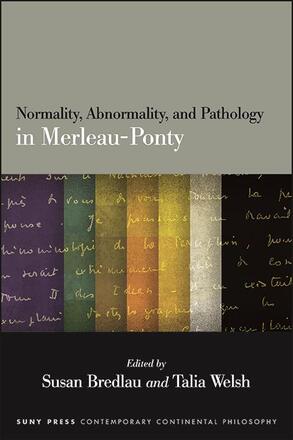
New Chapter Published: The Need for Merleau-Ponty in Foucault’s Account of the Abnormal

My chapter has been published in an edited collection on Merleau-Ponty. The title of the chapter is “The Need for Merleau-Ponty in Foucault’s Account of the Abnormal” and is in the book, Normality, Abnormality, and Pathology in Merleau-Ponty, edited by Talia Welsh and Susan Bredlau. You can purchase the hardcover on Amazon or at SUNY press. The paperback should come out in late summer 2022.

Here is a pdf of my chapter.


Here is the abstract:

Due to both his historical contributions as well as the simple persuasive power of his writing, many of us are drawn to the work of Michel Foucault on the history of the abnormal. And yet, while we acknowledge the insights offered by his account of the abnormal, we may feel that something is missing from his historical narrative and wonder if it can be fully trusted. In this chapter, I will argue that we can only successfully draw on Foucault’s work on the abnormal once we recognize that it is Merleau-Ponty’s work in psychology that serves as its hidden foundation.

To do so, I begin by giving a brief summary of Foucault’s account of the abnormal according to his 1961 History of Madness and his 1974-1975 lectures entitled Abnormal. Foucault describes how the abnormal of the modern age comes out of an understanding of madness that can be traced in the previous ages. He then reveals some common historical structures present in each age; in particular, how the notion of madness is dependent on the societal constructions of the rational and the nonrational. But we are left asking: Where are these constructions coming from? And why is madness inextricably linked to our understanding of the rational and nonrational in every age? Foucault’s account of the abnormal seems to tell us how the notions of madness play out in society, but offers no explanation for why the historical structures are shaped in this way. 

I turn to Merleau-Ponty for aid and find that the very historical structures recounted by Foucault are actually rooted in Merleau-Ponty’s phenomenological patterns of the abnormal. Drawing on the Phenomenology of Perception, I describe the phenomenological foundation of the abnormal as a way to make madness both accessible and meaningful. We find that this foundation is precisely what is needed for the arbitrary historical constructions of Foucault. To close, I look at the presence of these patterns in the disorder of schizophrenia, demonstrating how the unity of a historical-phenomenological account of the abnormal can provide deeper insights into the experience of a mental disorder.

New Course Next Semester: Introduction to Phenomenology

I’m excited that I will be teaching a new course here at the University of Mary next semester (Spring 2022) called the Introduction to Phenomenology. Here is the blurb.

Introduction to Phenomenology (Dr. Venable), Spring 2022

Are you interested in studying philosophy from the ground up? Do you want to test how much you can learn about the human and the world just by reflecting on everyday experiences? Are you curious about the philosophy behind the theology of the body movement? 

This course will explore the roots, the approach and the application of the philosophical movement of phenomenology. To uncover its roots, we will begin by looking at the pre-phenomenological themes in Aristotle’s Metaphysics and by gaining an overview of transcendental phenomenology found in Husserl. Next, we will learn about the approach by testing it out ourselves! Each student will choose a specific personal experience (such as driving a car, brushing one’s teeth, or playing an instrument) and reflect phenomenologically on it. Paired with this project, we will consider key writings on phenomenological approaches (including Engelland, Sokolowski, Merleau-Ponty and Heidegger). Lastly, we will turn to applications of phenomenology as seen in the themes of the Theology of the Body by Pope John Paul II and in other works of modern ethicists.