I presented at the International Network of Philosophy of Religion conference which took place in Perugia, Italy on June 11, 2024. It was a wonderful conference connecting with old friends and meeting new ones. The location was beautiful overlooking several small cities including Assisi (where St. Francis was from).
Here is a picture from the back of the hotel.
The conference is both in French and English so I wrote my abstract in both. And like last time, I read my paper in English but read the longer quotations in the original French.
Title: Art Speaks the Unspeakable: Suffering of the World in Aesthetic Expression
Abstract. Responding to the discussion on solitude and tragedy (the “extra-phenomenal”), at our last conference, and reflecting on the crisis of our created world, for this conference, this paper looks to the power of art to speak into the silent spaces of deep suffering. Because there are events where no human language — not even the language of phenomenology — can offer us a satisfying response, art has an ethical obligation to speak to us in the midst of personal and global suffering. Drawing on Maurice Merleau-Ponty’s idea that art emerges out of silence, I will first offer further proof for why it is that art must speak of suffering. Next, I will describe how art fulfills this obligation due to its facility with the vocabulary surrounding suffering, for example, death and brokenness, as seen in illustrations from the art of the French existentialists, Simone de Beauvoir, Gabriel Marcel, Jean-Paul Sartre and Albert Camus. Lastly, I will present what art says to us in suffering to demonstrate its indispensability; for the uncompromising message of aesthetic expression reveals to us the fullness of reality, the hard and the good, unlike anything else.
L’art dit l’indicible: souffrance du monde dans l’expression esthétique
Le résumé. Répondant à l’échange sur la solitude et la tragédie (le “Hors-phénomène”), lors de notre dernière conférence, et réfléchissant sur la crise de notre monde créé, pour cette conférence, cet article se penche sur le pouvoir de l’art de parler dans les espaces silencieux de la souffrance profonde. Parce qu’il y a des événements où le langage humaine — même le langage de la phénoménologie — ne peut pas nous offrir une réponse satisfaisante, l’art a une obligation éthique de nous dire quelque chose au milieu de la souffrance personnelle et globale. Faisant appel à l’idée de Maurice Merleau-Ponty selon laquelle l’art émerge du silence, j’offrirai tout d’abord une preuve en plus du fait que l’art doit parler de la souffrance. Ensuite, je décrirai comment l’art remplit cette obligation par sa richesse de vocabulaire du domaine de souffrance, par exemple, la mort et le monde cassé, comme le montrent les illustrations des arts des existentialistes français, Simone de Beauvoir, Gabriel Marcel, Jean-Paul Sartre et Albert Camus. Et enfin, je présenterai ce que l’art nous dit dans la souffrance pour démonter sa nécessité ; car le message intransigeant de l’expression esthétique nous révèle la plénitude de la réalité, du dur et du bien, contrairement à toute autre chose.
I recently did an interview about my book! Giorgi Vachnadze has a youtube channel called, The Silence of Savoir, and he asked if he could host me for an interview.
It was really fun talking about the book with him. He had great questions and I think the video gives a good summary of the book! Thank you, Giorgi!
Enjoy the interview!
Interview with Venable on book, Madness in Experience and History
Giorgi Vachnadze has written a review of my book here at Phenomenological Reviews. Check it out!
I am very grateful to him for writing such a detailed and thorough review. It is clear that he carefully read my book. As a result, he is able to offer such an engaging synthesis of its contents. I feel that he captures the spirit of what I am doing. He also notes on the organization and accessibility of the book which I was happy to hear as that is always one of my goals in writing.
At the end of the review, Vachnadze criticizes the book for ultimately not being in the spirit of Foucault because I do posit a kind of unified account of the body. This criticism is not surprising as I know other Foucault scholars may feel similarly. But I believe that in order to say anything, we need to assume some kind of unity of meaning and, as I argue, even Foucault implicitly does this with his implied subject and his overarching unreason.
Nevertheless, I hope this review prompts many people to read my book and continue the conversation. Thank you, Giorgi, for the immense time and effort that you spent reading my book and writing this review.
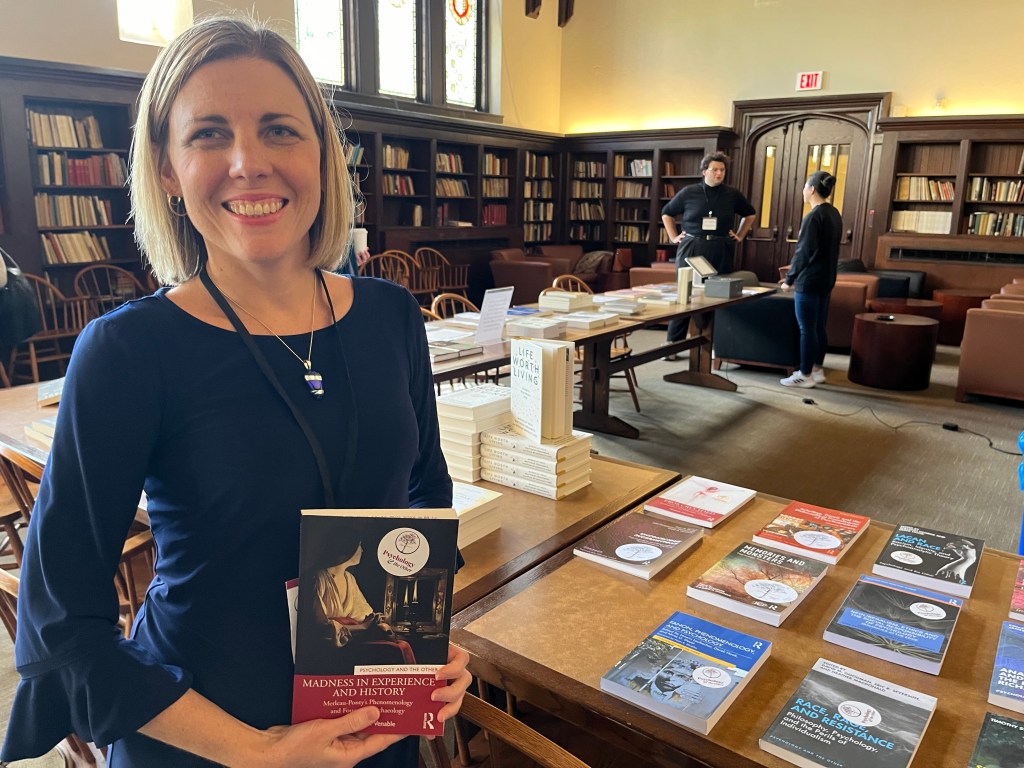
I offered two conference presentations at the Psychology and the Other Conference in Boston from October 6-8, 2023. It was a busy weekend but great conversations were had. My book was also sold at the conference. Here is a picture of me with my book at the book table.
My first paper was titled, “Practical Considerations for Schizophrenia, Major Depressive Disorder and Bipolar I Disorder: Drawn from Phenomenological Experiences and Historical Structures.” It was based on Chapter 8, the last chapter in my book.
Abstract:
Many agree that philosophy can contribute theoretically to a better understanding of mental health, but can it practically help practitioners? Without denying the benefits to a theoretical framework, my explicit goal in this paper is to provide practical tools that arise out of philosophy in order to better address three disorders: schizophrenia, major depressive disorder and bipolar I disorder. I discover these tools by bringing together two philosophical perspectives: an analysis of individual experience (using a phenomenological approach) and an analysis of historical background (using an archaeological approach). The phenomenological perspective will be guided by French philosopher, Maurice Merleau-Ponty and the archaeological perspective will be directed by French philosopher, Michel Foucault.
Beginning with schizophrenia, I will demonstrate how an experience of a hallucination comes from a nonrational behavior that is shared both in hallucinations and perceptions. This shared behavior is often overlooked due to the unspoken cultural structure that labels signs of nonrationality as moral failure. What we will find is that, even though there is no longer an explicit moral condemnation of schizophrenia today, the past and present historical structures help us identify one source for unexplained feelings of guilt experienced by many patients.
In regard to major depressive disorder, I will trace the structures of the world, such as spatial and temporal structures, that patients rely on in their state of sadness, to both understand their condition and secure a path forward. We will learn that the structures that patients depend on are not just bodily structures, but also cultural perceptions of depression which have changed over time. Surprisingly, these changes are not always due to observations of the disorder but are constructed to satisfy prior qualitative systems.
For bipolar I disorder, I will map the experience of a manic episode onto a spectrum of space centeredness. Although manic episodes demonstrate an extreme relation to space, we will find that usual human experiences are based on the same patterns of “lived space” which can range from decentered to overly-centered perceptions of objective space. Due to the variety in manifestations of this disorder, a cultural analysis encourages practitioners to treat a diagnosis of bipolar as a descriptive interpretation rather than an explanation.
The motivation behind these descriptions is to give a fuller — more human picture — to experiences of illness. From his decades of work in psychiatry, Arthur Kleinman writes that practitioners must consider the “illness” of a patient, which is the “innately human experience of symptoms and suffering,” in addition to the “disease,” which only includes the ordering of theories about a disorder.(fn) Following Kleinman’s appeal, this paper helps us see illness “as important as disease” by investigating an individual’s experience of a disease and the placement of that disease in our historical context.(fn) Although the applications offered in this paper by no means replace the medical accounts, they supplement them by grounding these disorders in the wider frame of our humanness.
My second paper was titled, “No Longer Foreign: Four Phenomenological Principles Drawn from Disability Studies.” This paper came out of my class that I taught in Spring 2023 on the Philosophy of Disability.
It is a common misconception that an analysis of abnormal behavior gives us insight into normal behavior by means of contrast. In other words, we may think that if we identify the defects and problems in abnormal behavior, we can then find the opposite to be true in normal behavior. Readers of phenomenological literature can sometimes be confused by the frequent discussion of disabilities and assume that these accounts are there to demonstrate the lack of something that is then present in those without disabilities. While phenomenology does not want to do away with distinctions entirely between the normal and abnormal, its purpose in addressing disability is precisely the reverse: a phenomenological account of disability gives us insight into human behavior — not because it is foreign — but because it reveals what is shared in all human experience. In fact, it is sometimes in the so-called abnormal behavior and experiences that we are best able to identify the fundamental human ways of encountering the world.
This paper would like to contribute to the growing discussion in phenomenology that exposes these shared human patterns by exploring one area in particular of disability studies: the bodily process of adaptation and learning for those with disabilities. I will argue that as we explore the experiences described here, we will find four common principles which apply to general human adaptation and learning. First, in consideration of cases of blindness, deafness and depression, we will see how humans rely on our bodies to take in the world. Second, in reviewing cases of spinal cord injury, we will find that the development of habits is through a gradual movement from the “I cannot” to the “I can.” Third, analyzing the use of technology for mobility, such as a wheelchair, we will discover how we all incorporate instruments into our experience of the world. And fourth, by looking at experiences in disability sports, we will discuss how we all receive satisfaction in healthy bodily activities.
The motivation behind the accounts in this paper is to bridge the gap between a disabled and non-disabled way of learning about the world. This is not to diminish the great achievements made by those who have had to adapt to challenging disabilities, but to humanize all ways of learning and adapting. In this way, we can relate and support one another in all manners of bodily experiences.
In terms of sources, the disability cases will be drawn from Berger and Wilber’s Introducing Disability Studies as well as other individual studies done on rehabilitation and recovery. The phenomenological approach for considering the cases will be drawn from Maurice Merleau-Ponty’s Phenomenology of Perception and Jean-Paul Sartre’s Nausea and Being and Nothingness.
I had the opportunity to present at the International Merleau-Ponty Circle in Washington D.C. on November 11, 2022. I was so excited that the theme of the conference was disability. The conference was titled: FITS AND MISFITS: RETHINKING DISABILITY, DEBILITY, AND THE WORLD WITH MERLEAU-PONTY.
Here is an abstract of my paper:
Equating the experience of suffering with the experience of disability runs contrary not only to a general understanding of human life, but also to a thoughtful approach to disability. To assume that disability is the same as suffering is certainly to misunderstand disability, as many others have shown. But, as I will argue, to assume that disability is the same as suffering is also to misunderstand suffering. Could it be that our incorrect view of suffering impacts the way that we see disability? I propose that, in order to understand the role that suffering may play in disability, we need to rethink what we mean by suffering and what kind of suffering could be present in disability.
To do so, I will briefly present some of the difficulties — philosophical, social, and practical — that are found in even discussing a relationship between suffering and disability. Second, drawing on Merleau-Ponty and Kierkegaard, I will argue for an expanded view of suffering where the good of suffering is not found in a future result, but in its placement in the present world and in its manifestation of joy in the present moment. Third, I will apply this expanded notion of suffering to disability in order to suggest what a reimagined relationship might look like between disability and suffering. While this new relationship is not meant to be universal nor comprehensive for all areas of disability, it does provide a helpful vocabulary that adds to a rich phenomenological account of disability.



 Through Wonder