I recently did an interview about my book! Giorgi Vachnadze has a youtube channel called, The Silence of Savoir, and he asked if he could host me for an interview.
It was really fun talking about the book with him. He had great questions and I think the video gives a good summary of the book! Thank you, Giorgi!
Enjoy the interview!
Interview with Venable on book, Madness in Experience and History
Giorgi Vachnadze has written a review of my book here at Phenomenological Reviews. Check it out!
I am very grateful to him for writing such a detailed and thorough review. It is clear that he carefully read my book. As a result, he is able to offer such an engaging synthesis of its contents. I feel that he captures the spirit of what I am doing. He also notes on the organization and accessibility of the book which I was happy to hear as that is always one of my goals in writing.
At the end of the review, Vachnadze criticizes the book for ultimately not being in the spirit of Foucault because I do posit a kind of unified account of the body. This criticism is not surprising as I know other Foucault scholars may feel similarly. But I believe that in order to say anything, we need to assume some kind of unity of meaning and, as I argue, even Foucault implicitly does this with his implied subject and his overarching unreason.
Nevertheless, I hope this review prompts many people to read my book and continue the conversation. Thank you, Giorgi, for the immense time and effort that you spent reading my book and writing this review.
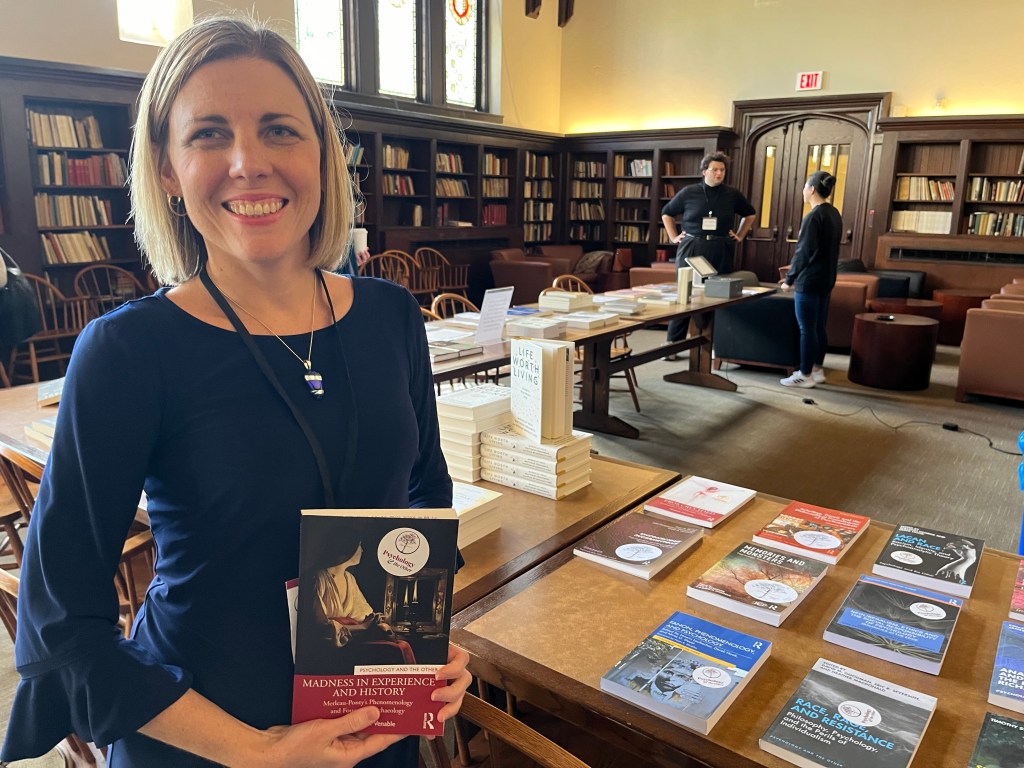
I offered two conference presentations at the Psychology and the Other Conference in Boston from October 6-8, 2023. It was a busy weekend but great conversations were had. My book was also sold at the conference. Here is a picture of me with my book at the book table.
My first paper was titled, “Practical Considerations for Schizophrenia, Major Depressive Disorder and Bipolar I Disorder: Drawn from Phenomenological Experiences and Historical Structures.” It was based on Chapter 8, the last chapter in my book.
Abstract:
Many agree that philosophy can contribute theoretically to a better understanding of mental health, but can it practically help practitioners? Without denying the benefits to a theoretical framework, my explicit goal in this paper is to provide practical tools that arise out of philosophy in order to better address three disorders: schizophrenia, major depressive disorder and bipolar I disorder. I discover these tools by bringing together two philosophical perspectives: an analysis of individual experience (using a phenomenological approach) and an analysis of historical background (using an archaeological approach). The phenomenological perspective will be guided by French philosopher, Maurice Merleau-Ponty and the archaeological perspective will be directed by French philosopher, Michel Foucault.
Beginning with schizophrenia, I will demonstrate how an experience of a hallucination comes from a nonrational behavior that is shared both in hallucinations and perceptions. This shared behavior is often overlooked due to the unspoken cultural structure that labels signs of nonrationality as moral failure. What we will find is that, even though there is no longer an explicit moral condemnation of schizophrenia today, the past and present historical structures help us identify one source for unexplained feelings of guilt experienced by many patients.
In regard to major depressive disorder, I will trace the structures of the world, such as spatial and temporal structures, that patients rely on in their state of sadness, to both understand their condition and secure a path forward. We will learn that the structures that patients depend on are not just bodily structures, but also cultural perceptions of depression which have changed over time. Surprisingly, these changes are not always due to observations of the disorder but are constructed to satisfy prior qualitative systems.
For bipolar I disorder, I will map the experience of a manic episode onto a spectrum of space centeredness. Although manic episodes demonstrate an extreme relation to space, we will find that usual human experiences are based on the same patterns of “lived space” which can range from decentered to overly-centered perceptions of objective space. Due to the variety in manifestations of this disorder, a cultural analysis encourages practitioners to treat a diagnosis of bipolar as a descriptive interpretation rather than an explanation.
The motivation behind these descriptions is to give a fuller — more human picture — to experiences of illness. From his decades of work in psychiatry, Arthur Kleinman writes that practitioners must consider the “illness” of a patient, which is the “innately human experience of symptoms and suffering,” in addition to the “disease,” which only includes the ordering of theories about a disorder.(fn) Following Kleinman’s appeal, this paper helps us see illness “as important as disease” by investigating an individual’s experience of a disease and the placement of that disease in our historical context.(fn) Although the applications offered in this paper by no means replace the medical accounts, they supplement them by grounding these disorders in the wider frame of our humanness.
My second paper was titled, “No Longer Foreign: Four Phenomenological Principles Drawn from Disability Studies.” This paper came out of my class that I taught in Spring 2023 on the Philosophy of Disability.
It is a common misconception that an analysis of abnormal behavior gives us insight into normal behavior by means of contrast. In other words, we may think that if we identify the defects and problems in abnormal behavior, we can then find the opposite to be true in normal behavior. Readers of phenomenological literature can sometimes be confused by the frequent discussion of disabilities and assume that these accounts are there to demonstrate the lack of something that is then present in those without disabilities. While phenomenology does not want to do away with distinctions entirely between the normal and abnormal, its purpose in addressing disability is precisely the reverse: a phenomenological account of disability gives us insight into human behavior — not because it is foreign — but because it reveals what is shared in all human experience. In fact, it is sometimes in the so-called abnormal behavior and experiences that we are best able to identify the fundamental human ways of encountering the world.
This paper would like to contribute to the growing discussion in phenomenology that exposes these shared human patterns by exploring one area in particular of disability studies: the bodily process of adaptation and learning for those with disabilities. I will argue that as we explore the experiences described here, we will find four common principles which apply to general human adaptation and learning. First, in consideration of cases of blindness, deafness and depression, we will see how humans rely on our bodies to take in the world. Second, in reviewing cases of spinal cord injury, we will find that the development of habits is through a gradual movement from the “I cannot” to the “I can.” Third, analyzing the use of technology for mobility, such as a wheelchair, we will discover how we all incorporate instruments into our experience of the world. And fourth, by looking at experiences in disability sports, we will discuss how we all receive satisfaction in healthy bodily activities.
The motivation behind the accounts in this paper is to bridge the gap between a disabled and non-disabled way of learning about the world. This is not to diminish the great achievements made by those who have had to adapt to challenging disabilities, but to humanize all ways of learning and adapting. In this way, we can relate and support one another in all manners of bodily experiences.
In terms of sources, the disability cases will be drawn from Berger and Wilber’s Introducing Disability Studies as well as other individual studies done on rehabilitation and recovery. The phenomenological approach for considering the cases will be drawn from Maurice Merleau-Ponty’s Phenomenology of Perception and Jean-Paul Sartre’s Nausea and Being and Nothingness.
I had the opportunity to do a full presentation for the first time at the International Network of Philosophy of Religion hosted in Paris, France on June 16, 2022. The conference is both in French and English so I worked hard to prepare my abstract in French and English. I read my paper in English but read all the quotations in the original French. I practiced before I went to make sure that I pronounced things correctly!
Abstract. In the spirit of our conference, titled, “En commun : Altérité, communauté et solitude,” this paper turns to the darker side of human community, the otherness of community, that can be displayed in cases of madness. To understand this otherness, we must consider the differing ways that historical and modern communities have shaped and responded to madness. It is here that we will uncover the human experience of the nonrational (déraison) lurking behind the narrative of madness. In this paper, I argue that even though madness depends on societal perceptions, there is an overarching nonrational, which cuts across history and remains the secret force behind the differing variations of madness. To make this argument, I will first create the milieu of madness according to three ages of European history as described in Michel Foucault’s History of Madness. Second, I will present the key themes of the overarching nonrational by looking closely at Foucault’s text. And third, I will offer some brief thoughts on how this approach can be applied to our view of mental illness today.
Le secret de la folie : la déraison globale de Foucault
L’abstrait. Dans l’esprit de notre conférence, intitulée, <<En commun : Altérité, communauté et solitude>>, ce papier se penche sur le côté sombre de la communauté humaine, l’altérité de la communauté, qui peut être affichée dans les cas de folie. Pour comprendre cette altérité, nous devons réfléchir aux différentes manières dont les communautés historique et moderne ont fabriqué et répondu à la folie. C’est là que nous découvrirons l’expérience humaine de la déraison (nonrational) tapie derrière le narratif de la folie. Dans ce papier, je soutiens que bien que la folie dépende des perceptions sociétales, il y a une déraison globale, qui traverse l’histoire et reste la force secrète derrière les variantes différentes de la folie. Pour le démontrer, je présenterai tout d’abord le milieu de la folie selon les trois âges de l’histoire européenne tels que décrits Histoire de la folie à l’âge classique de Michel Foucault. Ensuite, j’exposerai les thèmes importants de la déraison globale en examinant de près le texte de Foucault. Et enfin, j’offrirai quelques petites réflexions sur comment l’approche peut être appliquée à notre vision de la maladie mentale aujourd’hui.
My chapter has been published in an edited collection on Merleau-Ponty. The title of the chapter is “The Need for Merleau-Ponty in Foucault’s Account of the Abnormal” and is in the book, Normality, Abnormality, and Pathology in Merleau-Ponty, edited by Talia Welsh and Susan Bredlau. You can purchase the hardcover on Amazon or at SUNY press. The paperback should come out in late summer 2022.
Due to both his historical contributions as well as the simple persuasive power of his writing, many of us are drawn to the work of Michel Foucault on the history of the abnormal. And yet, while we acknowledge the insights offered by his account of the abnormal, we may feel that something is missing from his historical narrative and wonder if it can be fully trusted. In this chapter, I will argue that we can only successfully draw on Foucault’s work on the abnormal once we recognize that it is Merleau-Ponty’s work in psychology that serves as its hidden foundation.
To do so, I begin by giving a brief summary of Foucault’s account of the abnormal according to his 1961 History of Madness and his 1974-1975 lectures entitled Abnormal. Foucault describes how the abnormal of the modern age comes out of an understanding of madness that can be traced in the previous ages. He then reveals some common historical structures present in each age; in particular, how the notion of madness is dependent on the societal constructions of the rational and the nonrational. But we are left asking: Where are these constructions coming from? And why is madness inextricably linked to our understanding of the rational and nonrational in every age? Foucault’s account of the abnormal seems to tell us how the notions of madness play out in society, but offers no explanation for why the historical structures are shaped in this way.
I turn to Merleau-Ponty for aid and find that the very historical structures recounted by Foucault are actually rooted in Merleau-Ponty’s phenomenological patterns of the abnormal. Drawing on the Phenomenology of Perception, I describe the phenomenological foundation of the abnormal as a way to make madness both accessible and meaningful. We find that this foundation is precisely what is needed for the arbitrary historical constructions of Foucault. To close, I look at the presence of these patterns in the disorder of schizophrenia, demonstrating how the unity of a historical-phenomenological account of the abnormal can provide deeper insights into the experience of a mental disorder.



 Through Wonder