
I was accepted to participate in a Seminar and Conference this summer on Phenomenology and Revelation. It was an amazing 10 days at a retreat center in Long Island, New York with excellent presentations and deep conversations.
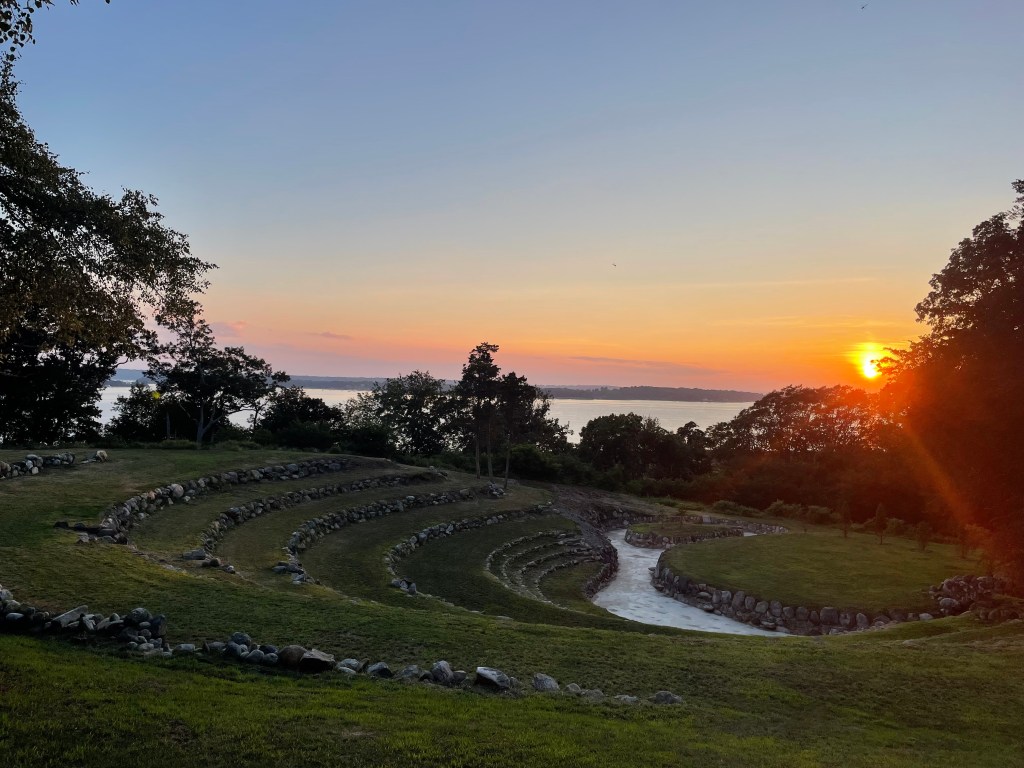
Here is a picture of the sunset at the retreat center overlooking the bay.
Abstract: No matter what angle we try, whether it is philosophical, theological or even practical, it is very difficult to make sense of suffering. Easy answers may suffice at first, but once we walk through a tragedy of our own or are exposed to some real suffering in the wider world, we are no longer satisfied and are compelled to search for something better. Although many perspectives can aid us in this, phenomenology offers a response to suffering that actually takes into account the magnitude and depth of the experience. This is because a phenomenological approach demonstrates concretely — not abstractly — how revelation is experienced in the midst of suffering in ways other approaches cannot do. More often, we focus on how revelation is something given prior to suffering in order to aid us in enduring it such as the promise of the land that the Israelites were given before they had to wander in the desert for forty years. Or we may think of revelation as a reward given after suffering such as the blessings that Odysseus receives after his long faithful journey through many hardships to return to his family. While these are important contributions to understanding revelation and suffering, phenomenology takes a radical stance by designating suffering as a mode of revelation itself. To illustrate this, I will first offer a phenomenological sketch of suffering, next describe what kind of revelation is available in suffering and conclude by arguing for the merits of drawing on phenomenology to establish the unique role that revelation plays in suffering.
 Through Wonder